How to Read a Stacked Area Graph
what is an area graph?
This article is function of our back-to-basics blog series called what is…?, where we'll interruption down some common topics and questions posed to us. We've covered much of the content in previous posts, and then this serial allows u.s.a. to bring together many disparate resource, creating a single source for your learning. We believe it's of import to accept an occasional pulse on foundational knowledge, regardless of where you are in your learning journeying. The success of many visualizations is dependent on a solid agreement of bones concepts. And so whether you're learning this for the first fourth dimension, reading to reinforce core principles, or looking for resources to share with others—like our new comprehensive chart guide —please join us as nosotros revisit and cover the basics.
An area graph is a specialized form of the line graph, where instead of merely connecting our data points with a continuous line, we also fill in the region below that line with a solid color. This might seem to be a small-scale cosmetic alter, simply information technology has a significant effect on how we perceive the data in the chart.
Expanse graphs can exist effective for:
-
Showing the rise and fall of diverse data series over time
-
Carrying total amounts over time as well equally some sub-chiselled breakdowns (but just to a point)
-
Emphasizing a office-to-whole relationship over time when 1 role is very large, or changes from being very large to very small
-
Showing change over time in private panels of a small multiple chart
Area graphs are not the ideal choice for:
-
Information sets on scales that exercise non have a meaningful relationship to goose egg
-
Showing several volatile information sets over fourth dimension
-
Showing fine differences in values
In this mail, we'll talk about how an area graph works, and some of the challenges to proceed in listen when you are considering creating one.
How does an area graph work?
Area graphs are the same equally a regular line graph, with two exceptions:
-
The space between the x-axis and each line in the graph is filled with some colour (perhaps of varying hue or opacity, depending on the designer'south preference).
-
The x-axis MUST Exist ZERO.
Here's a line graph of music sales over time in the U.S., cleaved down by format:

Remember that when we look at line graphs, nosotros focus on how the values on the vertical centrality change, up or down, as nosotros progress from left-to-right along our horizontal centrality, and we compare the lines to each other more than their acme from the x-axis. By their nature, line graphs are better at showing the change of values over time than an exact quantity at each measured point.
Our perception changes, though, when a chart creator adds a make full of color between the line and the baseline, transforming our line graph into an expanse graph.

Instead of seeing lines, nosotros see each data serial as a polygon, every bit a shape; and we judge each data series less by how it changes over time, and more by what nosotros perceive the overall surface area of the colored region to be.
An expanse graph transforms the purpose of the line graph from simply showing relative change over fourth dimension to additionally showing volume or quantity likewise.
For that reason, nosotros can't use scales on area graphs that don't have a meaningful human relationship to goose egg. Also, just like with bar charts, we must apply a nada baseline.
When are surface area graphs useful?
Expanse graphs are tempting to employ in lieu of line graphs. They are colorful, center-catching, and are uncommon plenty that the novelty factor tends to draw attending. As we discussed earlier, notwithstanding, line graphs and area graphs are non interchangeable, due to how viewers perceive the unlike presentations of data. We rarely (but not never!) notice ideal employ cases for the area graph. Still, here are a few cases for which the expanse graph might be a reasonable option.
Showing several series, across several different time periods, if there is significant variation among series and modify over fourth dimension
Sometimes, information technology's important to bear witness how quantities have changed over time across multiple related information series. Bar charts are expert at showing a quantity at i point in time, but multiple series across multiple points in time are challenging to show equally bars. The nautical chart gets crowded and cluttered very chop-chop.
The expanse graph attempts to requite a sense of quantity over all points of time, by creating irregular polygons of filled color. Where the information series overlap, still, information technology tin be challenging for the audience to read that 2 (or more) fills are occupying the same space.
Continuing with the aforementioned example we accept been using, which shows inflation-adjusted sales of music past format over time, we attempt to mitigate this challenge with a small change to the opacity of our "fill" colors, as shown below.
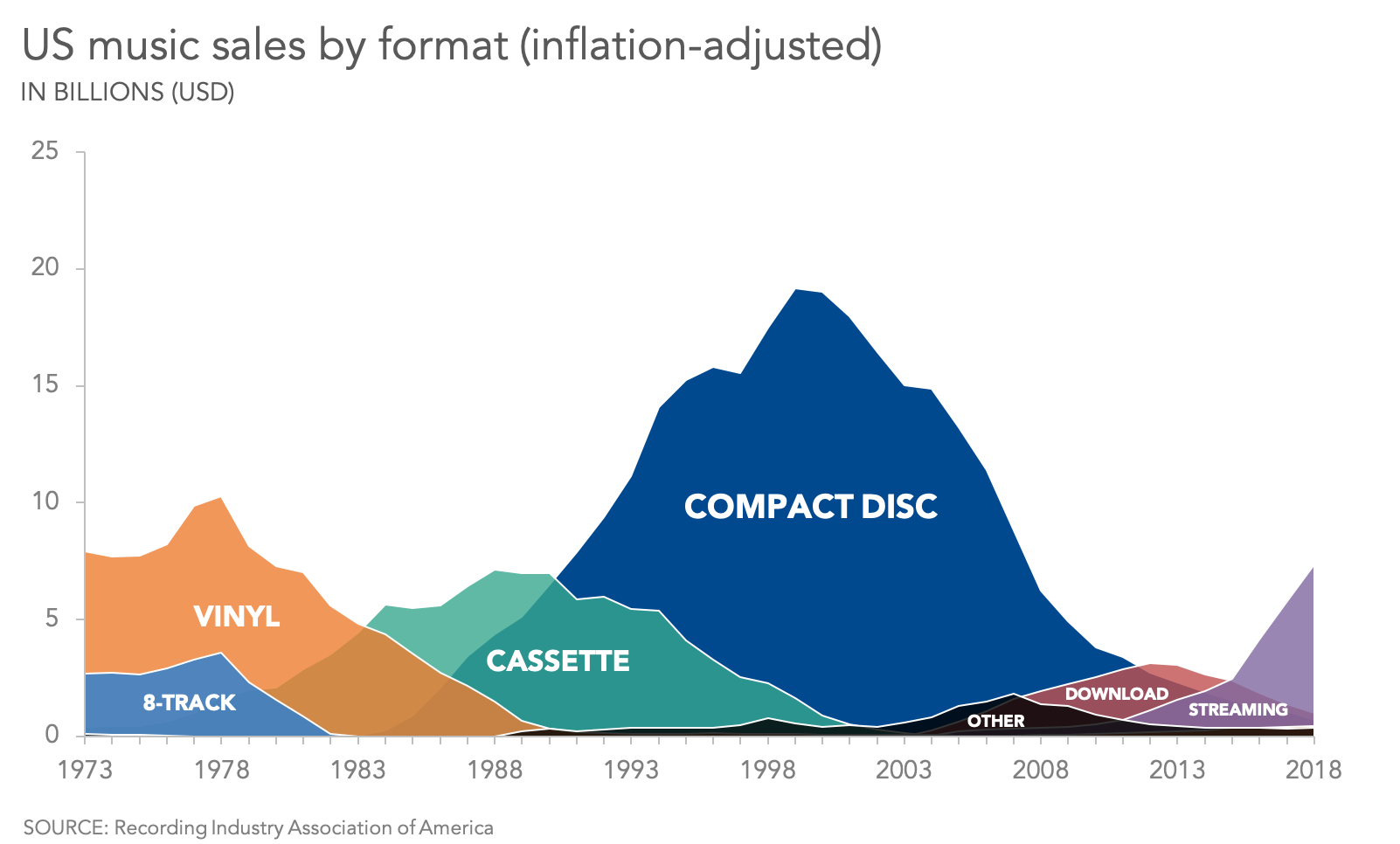
With purely opaque fills, we wouldn't know, for instance, how many Cassettes were sold before 1983, or how many CDs were sold before 1990. (It'due south all the same hard to see how many Cassettes were sold earlier 1979, because iii series are overlapping, and it's the "Cassette" data series that is pushed uttermost to the back. This type of graph also requires a designer to make thoughtful choices near data serial order.)
Showing several (or dozens) of series changing over time in a small multiple chart
Area graphs can exist useful in a pocket-size multiple chart (besides called a console chart or a trellis nautical chart). When yous have multiple data series, instead of overlapping them all on ane graph, you tin can display each of them equally a minor, single graph in a regularly-ordered series of similar charts. An expanse chart tin aid viewers compare quantity and change-over-time across those panels.

Showing the deviation between ii serial, or between a series and 100%
They can also exist useful if you are trying to show the gap between two (and but two) series, or between a series and 100%; and that gap is more important than the absolute value betwixt the lines. Shading the region betwixt the lines can emphasize that gap.
What are some challenges of area graphs?
This particular nautical chart blazon combines qualities of such controversial visualizations as chimera charts (comparing past surface area), stacked bar charts (comparing subcategories across categories), and scatterplots (allowing some data to be subconscious behind other information), while encouraging the use of color as a chiselled differentiator instead of a tool for focusing attention. Equally such, it's merely natural that surface area graphs have a few drawbacks.
In about cases, some of your data will exist hidden
Considering your information serial occupy the same space in your graph, they will inevitably overlap. The BEST case scenario is that your information series never cross over one another, so that the nautical chart looks similar a mountain range where all peaks are visible. More than likely, at least once in your nautical chart you lot'll see data series cross over i another, and so yous volition inevitably take hidden data.
Viewers tin can't always be certain what each series is using as a baseline value
Much like a stacked bar chart, the stacked expanse graph comprises subcategories that add up to a total value for each value on the x-centrality. Instead of each data serial going downwards to zero, they are stacked upwards on top of each other.
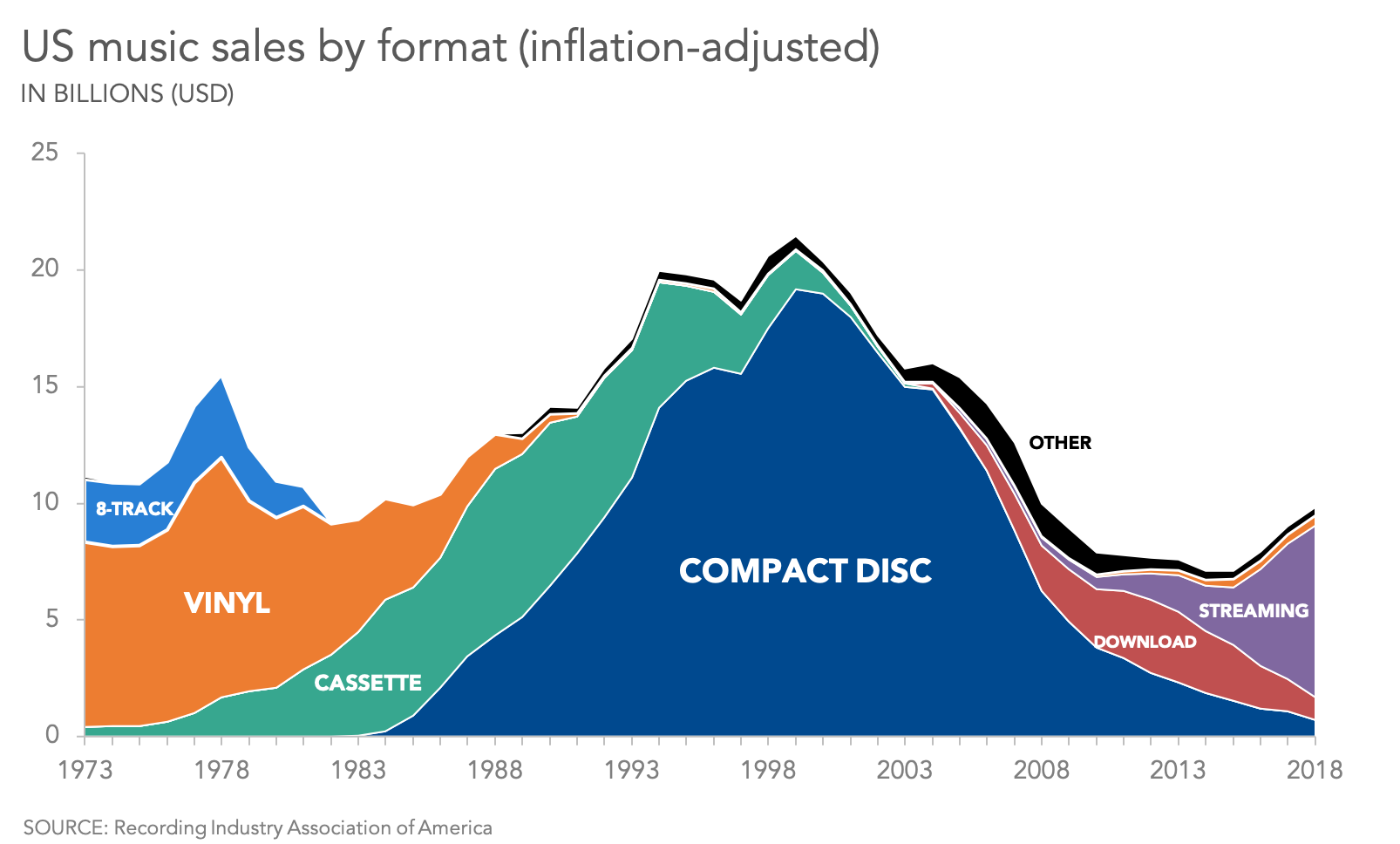
Question: In this chart, in 1973, how many billions of dollars of eight-tracks were sold? More than $10 billion, or about $3 billion? We can't be certain, because nosotros don't know if the chart we're looking at stacks all of the information serial on top of each other (so that the baseline for the "8-tracks" series is the meridian of the "vinyl" series), or if each series uses a common baseline of naught (so that the "8-track" series is mostly hidden behind "vinyl" and "cassette").
If each series DOES use a common baseline, then having semi-transparent fill colors will make that fact articulate. On the other hand, a stacked area nautical chart will never exist able to convince you with 100% confidence that it is, in fact, a stacked surface area chart, because there's ever the chance that it'south just a regular expanse nautical chart with opaque fill up colors.
Sometimes you will run across a variant of the stacked area graph called a streamgraph. In this version, instead of the lines stacking upwardly in one direction, they grow upward and down symmetrically.

With a streamgraph, there's less chance of information technology being mistaken for a pure area graph, but the cost of this is pretty high: you lose the ability to see fine detail, to include a labeled y-centrality, to brand easy comparisons across years.... Using a chart similar this might get some attending and encourage a viewer to engage with the information, only any real insight will likely require boosted charts, labels, and annotations.
Judging areas is difficult
People have difficulty judging relative areas, whether it's how much bigger one circle is versus another, how slices of pie charts compare, or the sizes of squares and rectangles that don't have common baselines. In an area graph, we accept an even tougher job: comparing regions of partially obscured irregular shapes. As you might imagine, this is nearly impossible to practise accurately.
For example, it is very hard to make visual comparisons across years for any data series that is not the one using the zero baseline. (On a streamgraph, this applies to EVERY series.) Is it obvious that 8-Tracks had more full sales than Downloads or Streaming? Is it easy to run across that VInyl and Cassette sales are within i% of each other? Not without the information labels. The continuous and irregular nature of the boundaries for each region in a stacked area graph make those comparisons even more difficult.
More ink, more overlap, more ataxia competing for attention
Finally, past their very nature, expanse graphs require a lot more than "ink" to convey not a lot more than information. An surface area graph with fifty-fifty a single data series is far more cluttered than a line graph; the more than serial we add together, the more than cluttered and hard to read information technology becomes. Focusing an audience's attention on one element of an area graph is even more challenging.
Are you ready to tackle an area graph for yourself? The April 2020 #SWDChallenge is your chance! Create and share your ain version of an area graph in the SWD community.
Or, go along your journey through our full what is…? chart series, by browsing other common visuals like bars and lines, or explore our comprehensive chart guide page for additional chart types.
How to Read a Stacked Area Graph
Source: https://www.storytellingwithdata.com/blog/2020/4/9/what-is-an-area-graph
0 Response to "How to Read a Stacked Area Graph"
Post a Comment