After Deworming Your Puppy Can You Deworm Again
Have you lot ever watched some of those veterinary shows on the Brute Planet network? My son, who is 8, loves the bear witness called "Monsters Inside Me," which focuses on people who get infections, notably those acquired by parasites. During an episode, he asked me if animals get parasites like people, and I replied, "Well, of course and a matter of fact, many animals harbor parasites that tin so get transmitted to other animals and people." The fact that a Boob tube series can focus on parasitic infections exemplifies their importance and interest to veterinarians and medical doctors.
This article focuses on parasites and puppies. Puppies are immature dogs, and the give-and-take "puppy" describes dogs from nascency to sexual maturity, which is effectually four to 6 months of age. Information technology varies depending on the breed. You may have heard the term "deworm" which is, basically, treating for parasites using drugs chosen anthelmintics. Given the term deworm, people seem to mainly retrieve near worms, only a couple of other categories of parasites are worth mentioning.
Common Parasites That Affect Puppies
There are 5 main groups of parasites that commonly infect puppies:
- Ascarids (roundworms)
- Nematodes (hookworms, heartworms, whipworms)
- Cestodes (tapeworms)
- Coccidia (Isospora, Cryptosporidium)
- Protozoa (Toxoplasma and Giardia)
But a few of these parasites can be easily seen: tapeworms, whipworms and roundworms. The remainder are microscopic, and they are identified in torso fluids, primarily in the feces. And then, if your puppy has diarrhea but you don't see any "worms" that doesn't hateful parasites are not the crusade! The most important existence roundworms, hookworms, coccidia and tapeworms.
What Parasites Are Near Common In Puppies?
While parasites can infect dogs at whatever life stage, puppies are a concern considering they don't have a mature allowed arrangement, they don't have a lot of fat stores to apply for energy and they have higher fluid intake demands than adults. Because most of the common parasites cause inappetance, diarrhea and vomiting, loss of fluid is more harmful to puppies than adult dogs. Some parasites are spread to puppies through their mother via the placenta or through female parent's milk — roundworms are a key example of this. The post-obit table gives you an idea of how common these parasites are:
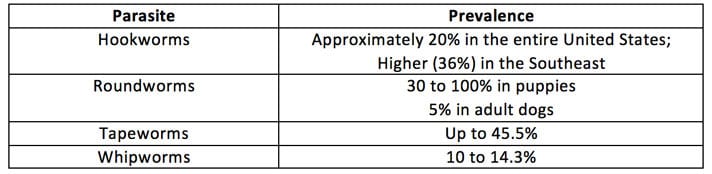
So, in puppies, the greatest business is infection with roundworms and hookworms because they are very common and cause serious affliction. Tapeworms and whipworms, while sometimes found as frequently or more often, don't crusade as serious of disease in puppies.
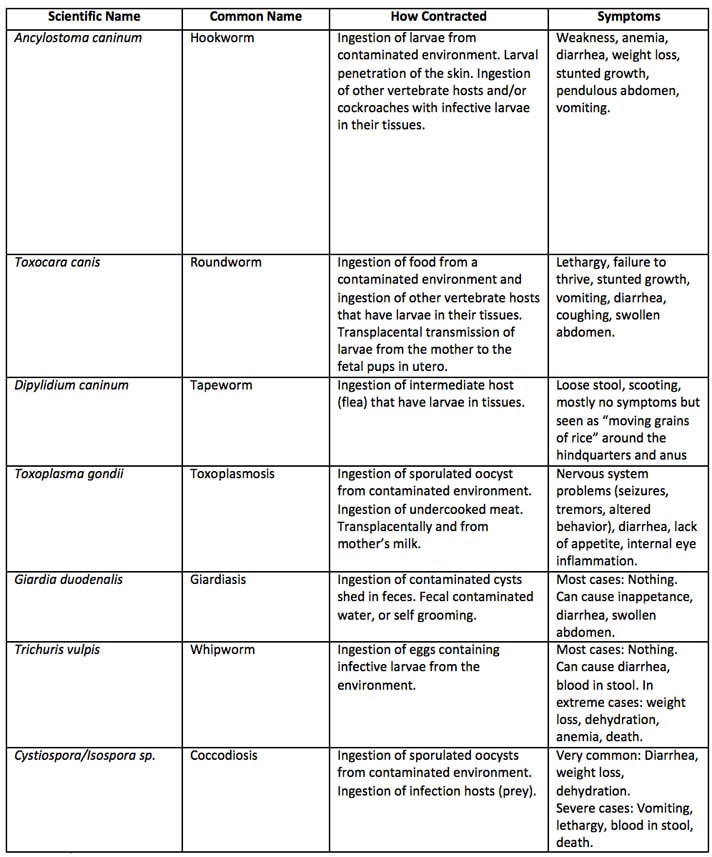
Symptoms And More Of Specific Parasites
Diagnosis Of Worms And Other Parasites In Puppies
Some puppy parasites are large enough to run across and can be constitute in the feces or on the areas around the anus. I would say the most common is the tapeworm. Tapeworms are made upwards of segments (proglottids) where their eggs are contained. They shed these segments in the stool, and many puppy owners see these segments in the stool, on their puppy'southward fur or on the ground. They look like small-scale maggots or cooked rice grains that move — YUCK!
Even if you see parasites in your puppy's stool, a veterinary should still examine him to decide exactly what is infecting your puppy. Choosing the treatment, knowing if the parasite is a danger to you, other pets or your family, and the demand for environmental/domicile cleaning all depend on the type of parasite causing the infection.
Have you ever been asked by your veterinarian to "bring in a stool sample"? Well, that'south what we examine to search for parasite eggs and microscopic parasites. This is the most mutual method to diagnose roundworms, hookworms, whipworms and coccidia. Other parasites, namely whipworms and Toxoplasma, don't shed their eggs routinely in the stool. There are other tests of the blood and serum for those parasites whose eggs are not readily found in feces; these are by and large used for Giardia.
Treating Worms And Other Parasites In Puppies
Many treatments are available for control of parasitic infections, and these come in many formulations: pills, chewable dog treats, liquid, granules added to dog food, pastes and injections. The benzimidazoles are most pop and include drugs similar fenbendazole, mebendazole and albendazole. This class of anthelmintics (anti-parasite drugs) are used to treat roundworms, tapeworms, hookworms and whipworms. A typical treatment protocol would be to give the product for one to three days and and so repeat the dosing in 2 to three weeks. The repeat dosing is used to impale the parasites that were not adults (eggs, larvae) during the first treatment but have at present "grown up." Most life cycles of puppy parasites are effectually three weeks long.
ther parasite treatments include praziquantel, used for flukes and tapeworms; pyrantel pamoate for roundworms and other nematodes; and macrocyclic lactones similar ivermectin and milbemycin found in heartworm preventives. So, by using most monthly heartworm preventives, you can also treat for intestinal parasites.
Side Effects Of Deworming Puppies
For the most office, the major classes of anti-parasite drugs (avermectins/benzimadizoles) have a very loftier margin of safety, pregnant that giving too much will rarely cause problems. That beingness said, always follow your veterinarian's recommendations for deworming.
Puppies with a large number of parasites (high worm burden) may become ill after treatment. Imagine all of the parasites in the intestines all dying at once, the lining of the intestines go inflamed, causing diarrhea, vomiting and lack of appetite. This is usually a self-limiting problem, and puppies are back to normal within a day or then.
Apply of heartworm preventive in higher doses (ivermectin) is very effective against most parasites; however, some breeds cannot tolerate the higher dose. This relates to a mutation in a gene called MDR-1, which codes for proteins that protect the brain (blood-encephalon bulwark). When dogs with MDR-one mutation get drugs like ivermectin, opiates (morphine-like painkillers) and chemotherapy, they can have serious bug similar lapsing into a coma, tremors and death.
Prevention: Puppy Worming Schedule And The Surround
Using many of the aforementioned drugs for treating parasitic infections will as well foreclose them. Current recommendations from the CDC and the American Association of Veterinary Parasitologists are to provide deworming medications against roundworms and hookworms at ii weeks of age, repeating the dewormer every ii weeks until the pups are 2 months old. Ideally, treat monthly from 2 months to 6 months of age to eliminate different developing stages of the intestinal parasites. Puppies should be dewormed using the to a higher place protocol despite fecal test results.
Puppies may have prepatent infections with minimal to no parasite eggs being shed in their feces.
Pregnant dogs should likewise be treated to try to foreclose transplacental infection to the fetal pups and to forestall transmission through nursing. Your veterinarian will provide a programme for you, because there are a few regimens available. Housing conditions and location are important factors related to parasitic infection. Puppies housed together, with frequent exposure to new dogs and puppies, are more likely to become infected. Unclean conditions, exposure to other animals' feces, and transmission from other creatures — like fleas, mosquitoes and cockroaches — increase the chance of infection, too.
Natural Dewormers
As with whatever medical production, there are persons who search for more "natural" ingredients. The problem is that at that place is little scientific data proving or disproving their effectiveness. Many products take multiple ingredients like sage leafage, fennel seed and papaya leafage. Although private ingredients can accept some degree of anti-parasite action, the exact dose and combination needed to kill and prevent parasites is largely unknown to the scientific customs.
Some naturalistic and holistic health care providers recommend products like diatomaceous earth and garlic to forbid parasites from infecting the GI tract. I could notice fiddling peer-reviewed, scientific information on whether that combination truly is effective in puppies. However, there was i paper in the periodical Veterinary Parasitology that stated garlic and papaya practise not command parasites in goats and lambs.
In my opinion, because the more modern dewormers (fenbendazole, praziquantel, pyrantel) are and so safe, proven and relatively inexpensive, there is no need to experiment with herbs and plants on your puppy to treat his or her worms.
Puppy Parasite Danger To Humans
Not merely practice many of these parasites cause disease in puppies, just some tin infect people and other species similar cats. Contagious agents that infect multiple species and spread from animals to humans are called "zoonotic." Hookworms and roundworms can invade cleaved skin, causing "larva migrans," which are parasites that migrate through an unsuitable host. Parasites need their hosts to not but become nutrient, but besides to complete their life cycle and reproduce.
When puppy parasites like hookworms, roundworms and Toxoplasma infect people, those parasites cannot complete their life cycle. However, they will cause problems! For example, say you lot are playing catch in the domestic dog park and bend downwards to necktie your shoelace. Then yous wipe your brow, unsuspectingly infecting your eye with a canis familiaris roundworm. Well, that worm can cause ocular larva migrans. Information technology will really abound and move effectually within your eye, and could cause incomprehension. Visceral migrans occurs when roundworms migrate through the inside of the abdomen, causing damage to internal organs. Canine roundworms are the leading cause of visceral and ocular larva migrans. Hookworms cause cutaneous larva migrans; they penetrate the peel and live nether the surface, creating red, irritated marks. I tell my kids that they are never to run effectually a sandbox or playground without their shoes on because stray dogs and cats frequent those areas to find nutrient from trash bins. Information technology's likely that they'll also urinate and defecate in those aforementioned areas, infecting the basis with parasites.
If you have children, then you lot've probably heard about toxoplasmosis, which is caused by Toxoplasma gondii, a very common parasite constitute in cats. Toxoplasmosis tin can crusade birth defects and death of the fetus, in dogs and in humans. This protozoan needs a feline host and virtually cats never get ill from it. They shed Toxoplasma oocysts in their feces. This parasite is not a major problem for puppies.
Coccidia and Giardia are likewise zoonotic and many dogs will have a few of these parasites just non have illness associated with them. Some experts believe that all dogs take coccidia and Giardia equally commensal organisms, similar the bacteria that live in your rima oris. Almost recommend only treating for these parasites if symptoms of vomiting, diarrhea and such are nowadays.
Cryptosporidium is a major problem in cows and other ruminants. Dogs are rarely affected, merely puppies and dogs with compromised immune systems can get sick, typically with vomiting and diarrhea. Luckily the strain that infects cows and people rarely is constitute in puppies. That strain led to a major outbreak of illness in Milwaukee dorsum in 1993. It was the largest waterborne outbreak of disease in U.South. history!
In The Know About Parasites In Puppies
I promise that yous now have plenty of data about parasites affecting puppies. Think, all puppies should exist treated from 2 weeks of age to 8 weeks of historic period, minimum. Products like fenbendazole are very safe and effective. Many parasites that your puppy may have tin infect you and your family, like roundworms and hookworms. Please speak to your family veterinarian about parasite control and stay abroad from "Dr. Google," where you'll find thousands of testimonials on how a homemade mash of herbs and such cured a puppy's whipworm infection.
Featured Image: alexsokolov/iStock/Thinkstock
By: Dr. Brian Roberts
palfreymanfacoure1979.blogspot.com
Source: https://be.chewy.com/deworming-puppies-what-to-expect/
0 Response to "After Deworming Your Puppy Can You Deworm Again"
Post a Comment